iPhones generally record standard videos as MOV files containing HEVC (H.265) or H.264 video. MOV is the file container, while HEVC and H.264 determine how the video is compressed. This explains why some iPhone recordings play normally on computers and websites while others need conversion.
Which Video Codecs Does an iPhone Use?
The iPhone Camera uses different video codecs depending on the recording settings. Two .mov files can behave differently during playback or editing, even when recorded on the same iPhone. The selected codec determines which playback and editing software can decode the video.
HEVC became available for iPhone recording with iOS 11 on supported hardware, starting with the iPhone 7 generation. It compresses video more efficiently than H.264, reducing storage requirements at comparable visual quality. H.264 remains widely compatible with older devices, editors, and playback software.
HEIC is a high-efficiency image format used for photos. HEVC is the video compression codec, despite the similar name.
Supported iPhone Pro models also record Apple ProRes for professional editing, with ProRes RAW available on compatible newer models through supported recording apps.
Some iPhones support AV1 video playback, starting with the iPhone 15 Pro and Pro Max. AV1 is used for efficient video streaming, but Apple’s built-in Camera does not record standard videos in AV1.
Does iPhone Record MOV or MP4?
The built-in Camera generally saves standard recordings as MOV files, including those encoded with H.264. MP4 is another container capable of holding compressed video and audio. Neither extension determines image quality or file size by itself; the codec, bitrate, and encoding settings have a greater influence on the result.
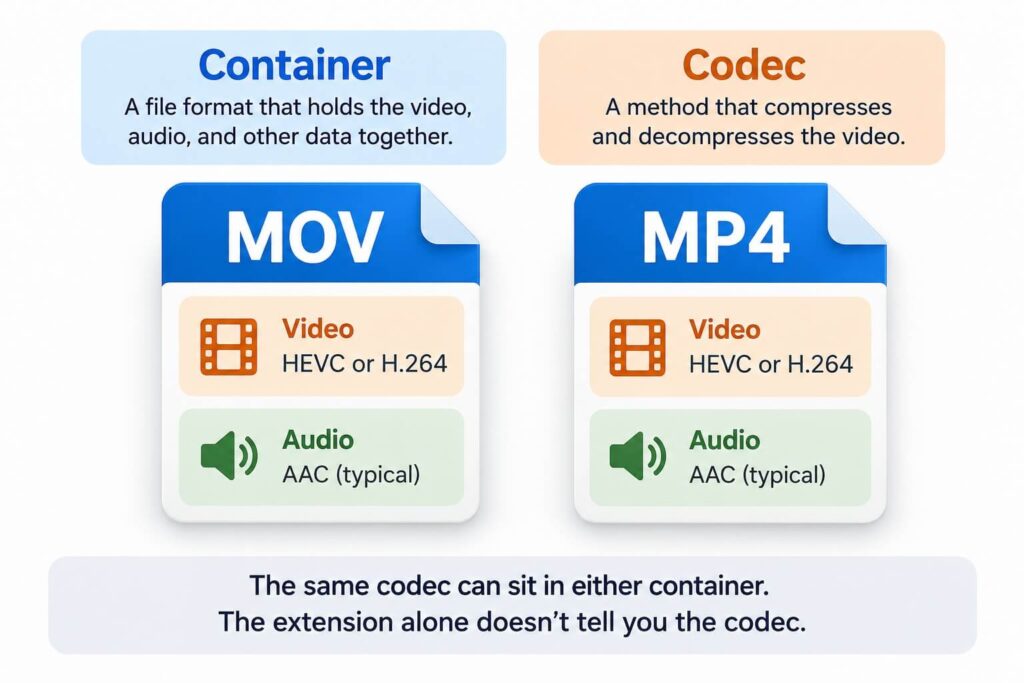
A website requesting an .mp4 upload is asking for a particular file type, not simply an H.264 recording. Apple documents that changing the extension of a compatible H.264 MOV file to .mp4 can satisfy that requirement without changing its video data. If the file uses HEVC or another unsupported codec, or the site rejects the renamed copy, a compatible export or conversion is needed.
How to Change the iPhone Video Recording Format
On a supported iPhone, Settings > Camera > Formats contains the High Efficiency and Most Compatible options. High Efficiency uses HEVC for ordinary video capture, while Most Compatible selects H.264 for new ordinary recordings. The same preference affects photo encoding, switching between high-efficiency photos and JPEG.
This setting applies to recordings made after the change and does not convert videos already stored in Photos. Selecting Most Compatible also does not instruct the Camera app to create MP4 files; a new H.264 recording can still have a MOV extension.
Resolution and frame rate use a separate control under Settings > Camera > Record Video. A 4K video contains more pixels than 1080p, and 30 fps means the camera captures 30 frames per second. Changing either setting does not change the container format, although resolution, frame rate, bitrate, and scene complexity all influence file size.
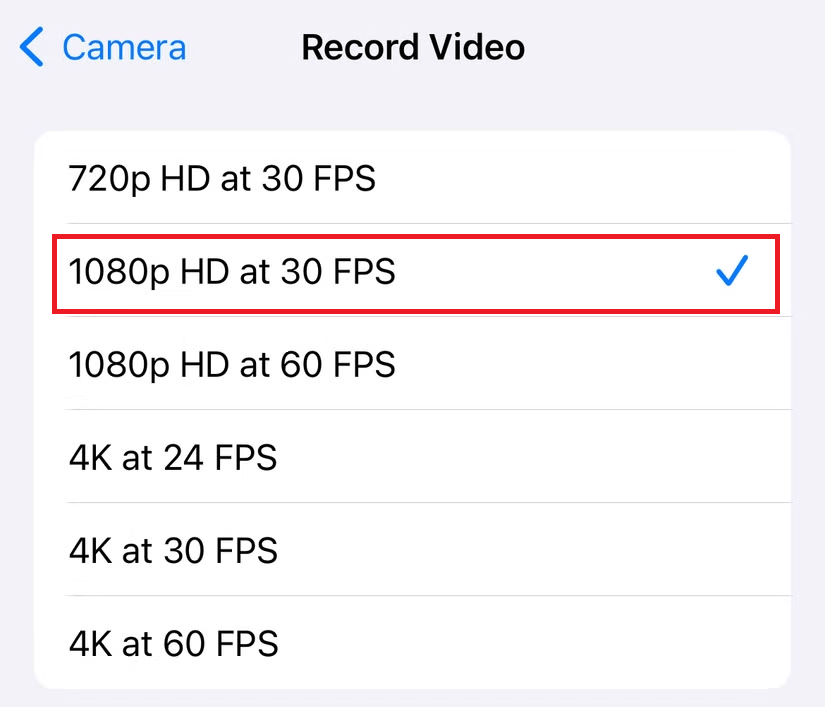
For reference, these approximate iPhone High Efficiency (HEVC) recording estimates show how storage use increases with resolution and frame rate.
| iPhone video setting | Approximate file size per minute |
| 720p at 30 fps (HEVC) | 40 MB |
| 1080p at 30 fps (HEVC) | 60 MB |
| 1080p at 60 fps (HEVC) | 90 MB |
| 4K at 24 fps (HEVC) | 135 MB |
| 4K at 30 fps (HEVC) | 170 MB |
| 4K at 60 fps (HEVC) | 400 MB |
Actual storage usage varies by device, settings, and video content. The iPhone also shows estimated storage beside each option in the Record Video settings.
HDR is another recording option on supported iPhones, controlled through Settings > Camera > Record Video > HDR Video. Dolby Vision is an HDR system, not a separate video codec, so a MOV file can contain HEVC video with HDR information. That additional color and brightness information requires compatible playback or correct color processing.
HDR video can appear washed out when playback software handles its color information incorrectly. Converting the codec alone does not fix that problem.
What Happens to Video Formats During Sharing?
A video received on another device is not always encoded identically to the original stored in Photos. Apple can automatically share HEVC footage in a more compatible format, such as H.264, when the receiving device lacks support for the original encoding. iCloud Photos preserves the original HEVC format, resolution, and frame rate.
The Photos share sheet has its own format controls, separate from Camera settings. Open a video, tap Share > Options, and choose Automatic to let the system select an appropriate format, Current to prevent file-format conversion, or Most Compatible to favor an accessible copy. Apple’s Most Compatible sharing option can still produce MOV video, so it is not a guaranteed MP4 export setting.
The same Options screen includes All Photos Data, available when sharing through AirDrop. Enabling it sends the original file together with its edit history and metadata, allowing the recipient to retain more than a finished viewing copy.
USB imports introduce another format choice. Apple documents that HEVC videos can be converted to H.264 during import to a computer. In the Photos settings, choosing Keep Originals under Transfer to Mac or PC prevents that conversion. The receiving computer still needs compatible playback software.
If the computer does not recognize the iPhone, resolve the USB connection problem before importing videos.
When Is MP4 Conversion Necessary?
A MOV file that will not open on Windows or in an editor is not necessarily damaged. The receiving software can support the MOV container but lack support for HEVC, a particular codec profile, or HDR processing. On Windows, VLC can play many MOV and HEVC recordings without conversion.
Microsoft’s HEVC Video Extensions, available through the Microsoft Store, can add HEVC playback to supported apps such as Photos and Media Player on PCs that do not already include the codec. Testing playback with VLC or after installing the extension can save an unnecessary export.
If the receiving program accepts MOV but cannot decode HEVC, exporting an H.264 version can resolve the codec incompatibility. Apple’s QuickTime Player can export H.264 video, but its video exports remain MOV files.
Before converting a recording, check which codec it uses. On the iPhone, open the video in Photos and tap Info or swipe up to see its filename and available details. Photos does not provide a complete codec report for every video.
Windows users can also inspect the video stream in VLC through Tools > Codec Information.
Convert an H.264 MOV File to MP4 on Mac
On a Mac, check the video’s codec before changing its extension. Apple’s method applies to compatible H.264 MOV recordings, and the renamed file must still be accepted by the receiving software.
- Check the codec: Select the video in Finder and open File > Get Info > More Info. Confirm that it uses H.264.
- Duplicate the recording: Make a copy of the MOV file to preserve the original.
- Rename the copy: Change its extension from
.movto.mp4. - Confirm the change: Select Use
.mp4if macOS displays a confirmation. - Verify compatibility: Open the renamed file or test it with the intended website.
Export an MP4 File Using iMovie
If the recording uses another codec or the renamed file is rejected, iMovie provides a way to export an MP4 copy.
- Create a project: Open iMovie on Mac and start a movie project.
- Import the video: Add the MOV file and place it on the timeline.
- Export: Select Share > Export File.
- Choose the output: Set the required quality and resolution.
- Save: Export the MP4 and check that it opens correctly.
Apple’s MOV-to-MP4 instructions cover both methods.
Keep the original recording when producing a compatible copy. Re-encoding can change image quality, file size, and metadata, and an exported copy does not necessarily preserve every feature of a ProRes or HDR source.
Conclusion
For everyday recording, the choice is mainly between HEVC’s storage efficiency and H.264’s wider compatibility. When sharing or editing footage, the receiving software’s format requirements matter more than the filename extension.