com.tmobile.pr.adapt is the package name for Device Manager, a preinstalled T-Mobile application that manages carrier-distributed software and device customization on compatible Android phones. Internally known as Adapt, it performs its tasks through background services without requiring you to open the application. You can disable it on phones that offer this option, but unwanted app installations can often be stopped without disabling the entire carrier component.
You might discover it in the system-app list, in battery usage statistics or as the installation source of an unfamiliar game. Older versions also appear under the name T-Mobile, which makes them easy to confuse with the carrier’s former account-management application (com.tmobile.pr.mytmobile), since replaced by T-Life.
What Does T-Mobile Device Manager Do?
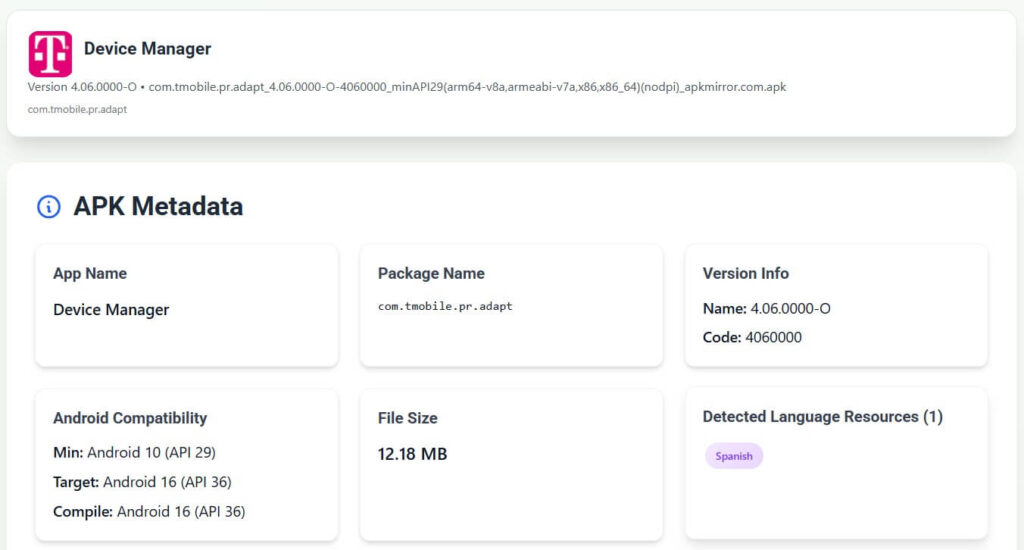
Our analysis of Device Manager version 4.06.0000-O identified software installation and branding components under the com.sprint.ce.updater namespace, also associated with Mobile Installer. These include routines for downloading carrier applications and modifying home-screen shortcuts, folders and wallpapers.
The application schedules carrier customization checks when the phone starts or a SIM finishes loading, and registers receivers for package updates. Remote messages received through Firebase Cloud Messaging can also trigger background tasks.
Adapt has been present on Android phones since at least 2015, when a device package inventory identified it as AdaptClient.apk in Android’s privileged system-app directory. Samsung’s Galaxy S9 application list also records version 3.29.0 on Android 8. The package appears on recent devices such as the Motorola moto g (2025), and the version we analyzed, uploaded in November 2026, targets Android 16.
Why Does Device Manager Install Apps Automatically?
According to T-Mobile’s AppSelector and AppManager documentation, AppSelector offers applications during initial device setup. Apps installed through it receive subsequent updates through Google Play. The related AppManager feature relies on Adapt or Content Manager to identify installed applications and deliver updates and notifications.
AppSelector sends its initial prompt approximately 15 minutes after setup or a factory reset. AppManager recommends new applications and identifies unused ones for removal, beginning 45 days after activation. On supported devices, these reviews recur at 45-day intervals unless the user opts out.
Device Manager requests Android’s privileged INSTALL_PACKAGES permission, which allows it to install applications without the ordinary Install unknown apps authorization when that privilege is granted by the firmware. We inspected its installation code and confirmed that it creates Android package installation sessions, writes application files and commits those sessions.
Researcher Ben Edelman’s 2025 code analysis of the AppLovin integration also documented an installation path through Content Manager (com.tmobile.dm.cm). A T-Mobile spokesperson stated in October 2025 that the associated advertising pilot had ended.
In a June 2024 Android Community report, a user described games attributed to Device Manager despite unknown-app installation being disabled. On phones that display installation-source details, the game’s app information page identifies its recorded installer, not necessarily the service that requested the installation or whether the user approved it.
Is com.tmobile.pr.adapt Spyware?
Device Manager is legitimate T-Mobile software with privileged capabilities. Its November 2026 APK contains functions for retrieving the device’s IMEI and the SIM subscriber identifier (IMSI), along with reporting components for application installations and first launches. These capabilities alone do not establish that the app functions as spyware or reveal which information a particular phone actually transmits.
Version 3.34.14, uploaded in January 2019, requested access to incoming SMS messages and Android system logs. Version 3.43.1, uploaded in March 2025, still requested SMS reception and listed Android’s PACKAGE_USAGE_STATS permission for usage statistics, but no longer listed system-log access. All three permissions are absent from the September 2026 build 4.05.0003-O and the November 2026 APK we inspected.
T-Mobile states that AppManager shares usage data with its software partner Unity and requires consent for that feature to operate. Its documented Usage Data Access control is consistent with the earlier permission listing, but is not necessarily available on every Device Manager build.
Does Device Manager Drain Your Battery or Mobile Data?
Software downloads and carrier configuration checks require processing power and network data when they run. T-Mobile specifies that standard mobile data rates apply to AppSelector usage.
Unusually high power usage has been reported since at least 2015. In a 2016 BlackBerry Priv discussion, a user reported reduced heat and improved battery life after disabling Adapt and revoking its permissions. Brief resource usage during a carrier update is expected; repeated high battery consumption when the phone is idle warrants investigation.
Apps installed through Device Manager occupy additional storage. Their subsequent battery and data usage should not be attributed to the installer.
How to Fix T-Mobile Device Manager Problems
Start with the recommendation and installation controls if unfamiliar apps keep appearing on your phone. Recurring crashes or excessive resource consumption require attention to Device Manager itself.
Note: Settings paths and available controls vary depending on the phone model, Android version and carrier firmware.
1. Revoke AppManager usage access
T-Mobile provides a usage-access control for withdrawing the permission AppManager relies on to operate. This targets the recommendation service without revoking Device Manager’s privileged installation permission.
- Open Settings and search for Usage data access or Usage access.
- Select Device Manager. If it is not listed, skip to method 2.
- Turn off Permit usage access, or the equivalent switch.
- Reopen the usage-access page to confirm the switch is off.
2. Manage AppSelector and AppManager recommendations
AppSelector and AppManager can be uninstalled without disabling Device Manager. Silencing their notifications only stops the alerts, not the recommendation service itself.
- To decline setup recommendations permanently, select Skip on the initial AppSelector prompt if it is still available.
- Dismiss AppManager reminders. Notifications stop after three dismissals.
- Alternatively, press and hold an AppSelector or AppManager notification and select Turn off notifications.
- To remove either recommendation app, open Settings > Apps.
- Select AppSelector or AppManager.
- Tap Uninstall, if available.
- Confirm that any recommendation app you uninstalled is no longer listed under Settings > Apps.
Games already installed through the recommendation apps need to be uninstalled separately.
3. Turn off Allow Installs
Device Manager 4.06.0000-O contains an application preference called Allow Installs, intended to control new app installations. Its presence in the APK does not guarantee that the phone exposes it in Settings.
- Open Settings > Apps.
- Enable Show system apps from the filter or menu if Device Manager is missing.
- Select Device Manager, or
com.tmobile.pr.adaptif listed under its package name. - Open Additional settings in the app or the equivalent app-preferences entry.
- If this option is unavailable, look for Content Manager under Settings > Apps and select Configure in Content Manager.
- Turn off Allow Installs if the option is present.
- Return to the preference screen to confirm the switch is off.
- Check your installed apps over the following days for further unwanted installations.
4. Troubleshoot excessive battery use or recurring crashes
Force-stopping Device Manager can temporarily interrupt abnormal background activity. For recurring crashes, clearing its cache removes temporary files that can interfere with operation without resetting stored application data.
- Open Settings > Apps > Device Manager.
- Tap Force stop and confirm.
- Select Storage and tap Clear cache, if available.
- Restart your phone if the error persists.
- On a Samsung Galaxy phone, open Settings > Battery > View details and compare Device Manager’s usage over a similar period of normal operation.
The current APK sets android:allowClearUserData to false, allowing Android Settings to block the Clear data option for this system package. If crashes return after restarting, contact the carrier with the installed version number and the circumstances in which the error occurs.
5. Disable Device Manager as a last resort
Disabling Device Manager prevents its own installation and customization services from running. However, the APK also contains carrier identification and access point name (APN) configuration code, and the consequences of disabling it are not established across all firmware versions.
- Open Settings > Apps > Device Manager.
- Select Disable, and confirm.
- Verify that calls, text messages and mobile data still work.
- Test Wi-Fi Calling and VoLTE if you normally use them.
- Return to its app information page and tap Enable if a carrier-related feature stops working.
If the previous methods fail and Disable is unavailable, contact T-Mobile support about the specific behavior you want to stop.
An unlocked phone can still contain software from its original carrier firmware. Finding Device Manager after switching to another network is therefore not, by itself, evidence that the former carrier is actively installing applications on your phone.
Related Android System Apps