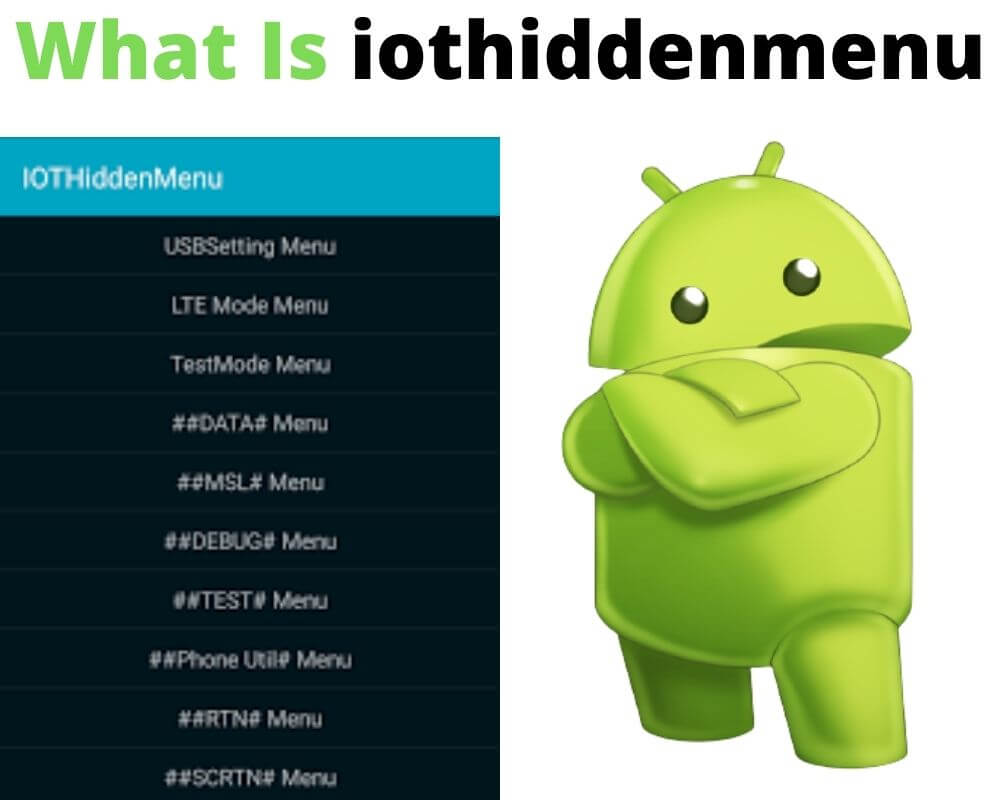
IOTHiddenMenu (com.sec.hiddenmenu) is a preinstalled Samsung system application that provides access to engineering menus for mobile network configuration, modem communication, and carrier provisioning. These menus support service technicians, network operators, and device testing.
The application has no regular launcher icon, which explains why users discover it under system applications or in their phone’s mobile data and battery usage statistics. IOTHiddenMenu is neither an Internet of Things (IoT) management application nor Android’s System UI Tuner, which customizes the status bar, notifications, and other interface elements. In mobile networking, IOT also stands for interoperability testing.
What Does IOTHiddenMenu Do?
Our examination of the IOTHiddenMenu version 16 APK identified the following menu labels in its code. They correspond to engineering functions documented on older Samsung devices:
| Menu | Function |
|---|---|
| USBSetting | Configures USB connection and modem diagnostic modes. |
| LTE Mode | Controls cellular network operating modes. |
| TestMode | Provides access to ServiceMode and radio testing tools. |
| DATA | Displays and modifies carrier data profiles. Incorrect settings can disrupt connectivity. |
| DEBUG | Provides network diagnostic information. |
| MSL | Handles carrier programming authentication and settings. |
| Phone Util | Configures phone and modem communication paths. |
| RTN | Provides reset functions that can erase user data. |
| SCRTN | Resets carrier provisioning and can restart the device. |
The package also contains activities for LTE frequency bands, carrier aggregation, Voice over LTE (VoLTE), SMS over IP, and multimedia messaging configuration. Its code references Samsung’s radio interface layer (RIL), through which Android’s telephony framework communicates with the cellular modem.
Although many of its original menus were associated with Sprint and CDMA devices, Samsung-signed versions exist for Android 14, 15, and 16. The current APK contains carrier-specific firmware checks, so the presence of a particular menu in its code does not establish that it is accessible on every Galaxy device.
Can You Still Access IOTHiddenMenu on Samsung?
A 2014 service code list extracted from Samsung’s Keystring_factory.apk identifies ##433346# as an IOTHiddenMenu code, and the sequence 433346 also appears in the compiled code of version 16. On older Galaxy devices, activity shortcut tools such as AnyCut opened its engineering menus.
However, the main IOTHiddenMenu activity requires the com.sec.android.app.hiddenmenu.permission.KEYSTRING permission, so an activity shortcut cannot bypass the application’s access restrictions. No universal access code is documented for current Galaxy models.
Samsung’s other engineering menus are accessible through separate dialer codes on supported devices. For example, *#9900# opens SysDump, a diagnostic tool for collecting system logs.
The APK’s secret-code receiver handles a LOG event that directs an intent to com.sec.android.app.servicemodeapp.SysDump, although 9900 is not registered directly in IOTHiddenMenu’s manifest. By contrast, *#0*# opens a separate hardware testing interface.
Why Does IOTHiddenMenu Use Mobile Data and Battery?
IOTHiddenMenu version 16 declares android.uid.phone as its shared user ID (UID), and 199 of its 220 activities are assigned to the com.android.phone process.
Android records network usage and battery consumption statistics by UID. When several packages share an identifier, the figures associated with IOTHiddenMenu can include activity from other telephony components. The examined APK does not independently declare the INTERNET permission, although permissions can be shared between packages operating under the same UID.
The package also contains HiddenMenuBootCompletedReceiver, which responds to Samsung’s LAZY_BOOT_COMPLETE event. Its carrier-dependent initialization and configuration checks explain why the application can execute without the user opening a menu.
Is IOTHiddenMenu Spyware? Can You Disable It?
The original IOTHiddenMenu package is a legitimate Samsung system application, listed in the manufacturer’s official firmware application inventory. Its presence is not evidence of spyware, remote control, or unauthorized access to your phone.
The application declares privileged permissions including MODIFY_PHONE_STATE, MANAGE_USB, WRITE_APN_SETTINGS, and READ_PRIVILEGED_PHONE_STATE. These permissions support its access to telephony information and network configuration beyond the privileges available to ordinary applications.
On some Samsung devices, the Disable and Force stop buttons in App info are unavailable. Leave the package enabled because disabling it prevents its engineering activities and carrier event receivers from operating.
How to Fix Samsung Hidden Menu Codes Not Working
Samsung’s One UI Beta Team has acknowledged that software updates can affect secret codes through changes in permissions, security policies, or application compatibility. The following steps address dialer-level restrictions rather than granting access to protected IOTHiddenMenu activities.
1. Use Samsung Phone as the default dialer
Third-party calling applications do not necessarily implement Samsung’s proprietary secret-code handling. When another dialer is selected, switching to Samsung Phone allows the manufacturer’s application to process the code.
- Open Settings > Apps.
- Tap Choose default apps.
- Select Phone app.
- Choose Samsung’s Phone application.
- Open its keypad and retry the code that previously worked.
2. Check Auto Blocker
Samsung’s Auto Blocker feature can interfere with dialer codes on devices running One UI 6 or later. Samsung support moderators have recommended temporarily turning off this feature when secret codes fail to execute.
- Open Settings > Security and privacy.
- Tap Auto Blocker.
- Temporarily turn it off.
- Enter the supported code in the Phone application and check whether its menu opens.
- Re-enable Auto Blocker after completing the test.
For hardware checks that do not require engineering settings, Samsung provides built-in diagnostics through Samsung Members > Discover > Diagnostics > Phone diagnostics. This is an alternative to the hardware test menu, not a way to access IOTHiddenMenu.
When investigating a menu that stopped working after an update, check the service provider software version under Settings > About phone > Software information. Providing this information alongside the device model and One UI version helps Samsung identify whether the missing functionality is specific to your firmware.